Monday, December 3, 2018

Rube Goldberg Machines

Our next Physics adventure is going to be constructing Rube Goldberg machines.
Get some inspiration here - start imagining your design!
Videos

Monday, November 19, 2018

Insultated Cup Reflection


To Do: Complete by End of Lesson

1. Graph your results in Excel - cut and paste your *titled* graph into Paint and save as an image.

2. Upload your graph to the class Padlet Insulated Cup Graph Padlet Don't forget to put your name!

3. Fill in the reflection form here Insulated Cup Reflection Form


Finished?

Our next Physics adventure is going to be constructing Rube Goldberg machines.
Get some inspiration here - start imagining your design!
Videos


Monday, September 10, 2018

Chemistry Inquiry

This will be your major assessment for Chemistry - you need to draw on your experiences of doing inquiries during the microbes and heart rate units.

Here is a copy of the assignment sheet (download)
Want to self assess? Have a look at the self assessment sheet
The German Guy Talking about GOOD POSTER DESIGN: Poster Design Video

Background Reading:


Nailed It This question is about corrosion.  
Find out more about corrosion here:  BBC Bitesize Corrosion or Rust Doctors website
Find out more about galvanising: Galvanising Simple Wiki
For a comprehensive example of an experiment: Nuffield Experiment Example
For a simplified experimental set up: Sciencing Experiment Example


Sour Grapes: This question is about pH.  
Learn more about pH here: Science Buddies pH ( or more advanced)  Chem4Kids Acids & bases
Impacts of acids on the body (**be very carefuly researching this, there is a lot of fake science out there) Try Healthline Acids


Speedy Seltzers  This question is about Changing the Rate of Chemical Reactions.
Learn about rate of reaction here: Chem4Kids Chemical Reactions
An example experiment is here Science Buddies Rate of Reaction


Solid, Liquid or Gas? This experiment is about exploring viscosity and how it impacts the properties of non-newtonian fluids  You'll need to talk a bit more to McW about it!
Here's an overview of solids, liquids and gases BBC Bitesize
A very comprehensive article about non-newtonian fluids
Learn about non-newtonian fluids here:  Wikipedia


Tuesday, August 14, 2018

The Periodic Table

The periodic table can be as simple or as complicated as you want it to be, I'd like us to land somewhere about half way between these two points in this next activity.

Your Aim: Is to familiarize yourself with the complexities of the period table - identify how it is arranged and begin to memorize some of the element symbols*


What you'll do: 
In a group of 3 each grab a copy of the periodic table.

As a whole group: Make a Quick Poster on A3 Paper:

* How is the periodic table arranged?
* What do the horizontal and vertical groupings mean?
* What are the differences between metals, metalloids and non-metals?

Role 1: To investigate the properties of metals (there are a number of sub-groups that fall into this category), and put forward 5 common metals that you will work on memorizing the symbols for. Colour in the sub-groups one colour-scheme (ie shades of red) and write the special properties of this group.

Role 2: To investigate the properties of non-metals (the 3 groups that fall into this category), and put forward 5 common non-metals that you will work on memorizing the symbols for. Colour in the 3 groups one colour-scheme (ie shades of blue) and write the special properties of this group.

Role 3: To investigate the properties of semi-metals (also called metalloids).  Put forward 5 common semi-metals metals that you will work on memorizing the symbols for.  Colour in this group and highlight the zig-zag line that separates metals from metalloids.  Write the special properties of this group


Your assessment (no grade given, this is simply P/F)
  •   A test on memorizing the 15 symbol names that you have chosen as a group (during the main chem test on the 23rd)    
  • Your A3 Periodic Table; with its notes.
  • Your lab notes


Good Resources:


Interactive: The Periodic Table (skip to the interesting parts)


Wednesday, August 8, 2018

Sunday, August 5, 2018

Heart Rate Inquiry Marking Guide


Find it here:

Heart Rate Inquiry Marking Guide

If you've lost your sheet then download the guide, delete any of the marking stuff and input your own info x

Monday, June 25, 2018

I HEART U


1. Do some revision of the Cardiovascular system via BBC bitesize

2. Meet your heart  Take notes! 

3. Build a Tiny Heart Use plasticene, do it on a paper plate. 

4. Label your tiny heart with all the directions of blood flow and veins and arteries. The video below might help.

5. Watch Khan Academy: Heart Beat

6. You may find this video also helpful Human Heart Video

7. Watch a heart dissection before you do it


Thursday, May 31, 2018

Mythbusting Microbes


Here is a link to the writing frame (your assignment sheet)
Mythbusting Microbes Write Up

1. Save a copy.
2. Open it up in docs.google.com to begin your work.  Click 'share' and 'view only' and copy the link.
3. Go to 8R SHEETS or 8G SHEETS
5. Write your name and leave the link to your work
6. Now get back to work, knowing your work won't be lost or need to be handed in!

-- Feel free to invite me to edit your work taroonawork@gmail.com --


Here is the link for interpreting your plates
Science Buddies: interpreting agar plates

I will put additional supporting material up here asap!

Sunday, April 29, 2018

Intro to Cell Organelles

Wednesday: Finished Early?
Why not play some RADICAL CELL GAMES

Centre of the Cell Games

Biomanbio Cell Games


1. Watch a couple of videos to give yourself an overview of what is inside the cell

Try: Biology Cell Structure Video

or try: Amoeba Sisters Grand Cell Tour

If you're interested in the idea of your cells being alive watch this In a Nutshell: What Are You?


2. Use the interactive at Sepup Cell Simulation to fill in your worksheet.  Filling it in in pairs is fine BUT make sure you keep the information safe - you'll need it!

Here's some puppies on a treadmill. Say 'stay fit pupper' three times and all your dreams will come true.


Sunday, March 25, 2018

ROCKS!

Resources

Your test on Thursday will involve:

1. Being able to describe the differences and similarities between igneous, metamorphic and sedimentary rocks.
2. Be able to describe how I/M/S rocks are formed
3. Be able to describe the features of a I/M/S rock
4. Identify a few different types of weathering and how it impacts rocks
5. Understand the difference between weathering and erosion
6. Identify a few common types of I/M/S rocks
7. Interpret fossils using ideas from the assignment
8. Make assumptions about igneous rocks from their crystal size


A Copy of the Power-Point from class
Geology Notes from Class

Inside the Earth & Tectonic Plates
Dynamic Earth Interactive

Crystal size and cooling rate
How is crystal size affected by cooling rate?

How Rocks are formed:
Rock Cycle

The Mohs Scale: Ranking rocks by hardness

Hardness of rocks

A pictorial guide of rock comparison
Igneous vs Sedimentary vs Metamorphic in pictures

Comparing Sedimentary, Igneous and Metamorphic Rocks
Science by Doing

This video is both extremely boring and interesting at the same time
Rock forming minerals: What are rocks mostly made of?

Another boring/interesting vid summarizing differences between M/I/S rocks

Sunday, March 4, 2018

Crystals and Cooling Rate Write Up


Discussion Questions > Either a digital or hardy copy please.

1. What is the purpose of this experiment and what do you predict will happen?

2. Make a copy of the table below and fill it in.

3. When your results are done, write a description of what you observed. Be sure to be specific and detailed in your observations.  What did you find? Was it what you expected? How did it compare to the class?  Why might it have been different to expectations?  Compare how your crystals look compared to another Year 8 student Sarah Jones in this video 

4. How does this experiment relate to igneous rocks?  Be sure to include your understanding of the rock cycle and the types of intrusive and extrusive rocks. As part of this explain why some igneous rocks, like pumice or obsidian, appear to have no crystals.  Conversely, rocks like granite seem to be full of many crystals.  Explain why this might be. 
Here is a section on the text-book to help

Table for Question 2.
Test Tube
Observations of
Ice Crystals
Observations of Air Crystals
Observations of
Cotton-Wool Crystals
Rate of Cooling (fast/slow)


Type of igneous rock that cools in similar fashion


Observations of crystals in experiment


Size of crystals in similar igneous rocks (large/medium/unnoticeable)


Tuesday, November 28, 2017

Getting Your Research Right!

Introduction: 
: a) Follow the link http://bit.ly/2BwdVpm 
  b) Fill in the columns in the Padlet https://padlet.com/kate_meijers/rnvk5autjt5o 


Step 1: Improve Your Search Terms

Using more effective search terms reduces your chances of getting unreliable webpage suggestion

Your Search Terms Matter! Click to Enlarge

Partner 1: The Art of Key Word Choices
Visit

Do the Activity
Visit

Do the activity
Explore using these tips, select and test your favourites to share with your partner

Partner 2: Word Order & Finding Words  
Visit

Do the Activity
Visit

Do the activity

OPTIONAL Already know about CTRL+F?  Learn how to search different content
Do the activity


Step 2: Take steps to be more analytical of webpages

Go back to the original search http://bit.ly/2BwdVpm  

Use the "Cheat Sheet to Researching Effectively" and the who/what/when/where guide to appraise your "most reliable website" and "least reliable website".  In pairs, do one each and then come back to discuss.

Have you changed your mind? Is this still the most reliable resource?


Summary: Have you improved?!

a) Follow the link http://bit.ly/2ibiQHy 


Thursday, November 9, 2017

Seasons


Use these resources to help you create your Earth Sun Seasons Model:

Crash Course Kids Seasons (Video)

Crash Course Kids Revolution & Rotation (Video)

Earth's Orbit put Simply (Video)

A model similar (but fancier) to what you will make (Video)

Equinoxes and Solstices Explained (Webpage)


From Wikipedia: Earth's Orbit

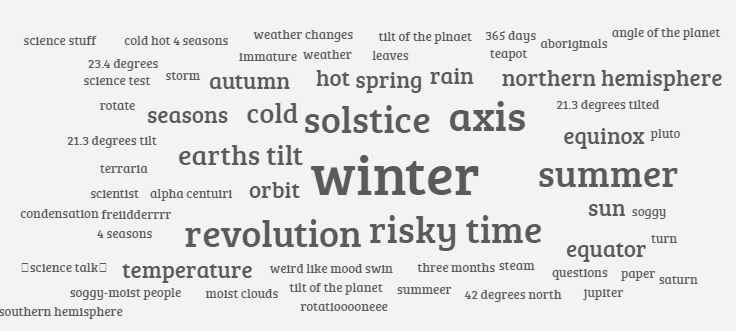
7R Word Cloud
7G Second Word Cloud 

7G World Cloud


Sunday, August 13, 2017

Classification of Animals

AIM of TODAY:
1. To learn about the system of classification that scientists use to classify living things
2. More specifically how it is used to classify animals. 


BY the end of the LESSON: 
Be able to compare animals and kingdoms according to the classification.

RESOURCES FOR 16th & 17th AUGUST (WEDNESDAY & THURSDAY)
Classification Game > For a bit of fun
Crash Course: Chordates  > Everything you'd ever want to know, really, really fast


- - - - - - - - - - - - - - - - - - - - - - -

OTHER HELPFUL RESOURCES
Australian Museum: Invertebrate Guide

Wednesday, August 9, 2017

Animals vs Plants

How do Scientists decide that a sponge is an animal, but a venus fly trap is a plant?

All these above organisms are actually animals! Click to Enlarge 
All these above organisms are actually plants! Click to enlarge
PLANTS
ANIMALS
Plants generally are rooted in one place and do not move on their ownMost animals have the ability to move fairly freely.
Plants contain chlorophyll and can make their own food
Animals cannot make their own food and are dependent on plants and other animals for food.

Plants give off oxygen and take in carbon dioxide given off by animals.Animals give off carbon dioxide which plants need to make food and take in oxygen which they need to breathe.
Plants cells have cell walls and other structures differ from those of animals.Animal cells do not have cell walls and have different structures than plant cells
Plants have either no or very basic ability to sense.Animals have a much more highly developed sensory and
 nervous system.


We have been investigating the difference between plant and animal cells by looking under the microscope.  One of the key differences is between the CELL structure.

What are Cells Though? 

Resources: 
Video 1: History of Cell Theory TED-ED
Video 2: Bill Nye the Science Guy: What are Cells

Question 1: 
Write a few sentences which summarise these two videos.  Focus on information about what cells are, how they were discovered and what they do.


What are the Differences Between Plant & Animal Cells?

Resources:
Interactive Plant vs Animal Cell .
Video: Nerdy Plant Cell meets Cool Animal Cell 

Question 2:
From the two resources compile a list that describes the differences between a plant and animal cell?

Question 3:
What reasons does the video suggest for differences between plants and animals?


Sunday, July 30, 2017

Is it Alive?

We are looking at the very broadest way to classify life.  The first branch of our world's dichotomous key if you will.


We have developed a pretty good list of what defines a living thing.   We can easily see that things like dogs are alive.  

Denison looking very much alive

BUT. What about things like yeast? Is yeast alive?

What is Yeast? Scan over the Wikipedia page about yeast.  Take a few brief notes.

Ok so yeast is alive: but why?  You need to do a bit of research and some experimentation to work this out:

Apply the MRS. C. GREN process to find out why Scientists thing yeast is alive.

Look at each of the links below to  find evidence as to why we think yeast is alive. Take a few notes in your book as evidence.

Respiration   - Time to experiment! See Mrs. McW.

Reproduction -  BBC Bitesize Yeast 
Excretion - Your experiment should also answer this question! 
Nutrition - Your experiment should also answer this question! 


Wednesday, June 28, 2017

Chemistry Test

7G your test is Monday 3rd July
7R your test is Tuesday 4th 

Key Topics Covered:

TOPIC
WHAT:
KEY VOCAB
RESOURCES
Solid, Liquid, Gases
       Properties of each
       Atomic structure
       Condensation
       Evaporation
       Melting
       Solidifying
     Science blog
     Venn Diagram
Solutions
       Methods of separating
       Vocabulary
       Solutions
       Solute
       Solvent
       Soluble/Insoluble
       Saturation
       Filtration
       Evaporation
       Distillation
       Chromatography
     Science blog
     Write ups in book
Suspensions & Colloids
       Methods of separating
       Identifying
       Vocabulary
       Colloid
       Suspension
       Flocculation
       Emulsifier
     Science blog
     Science sheet


Extra Information:

Solids Colloids and Suspensions


Tuesday, June 20, 2017

Chemistry: Last Day Chem Experiment

Your experiment for the last day of term should :

1. Be risk managed 
2. Be affordable 
3. Come with a set of instructions and equipment 
4. Have a clear learning outcome (what do we learn from this experiment?)


Some  good starting points are:


Leave your suggestion (ensuring it addresses the 4 key points above) in the comments below!