Monday, June 25, 2018

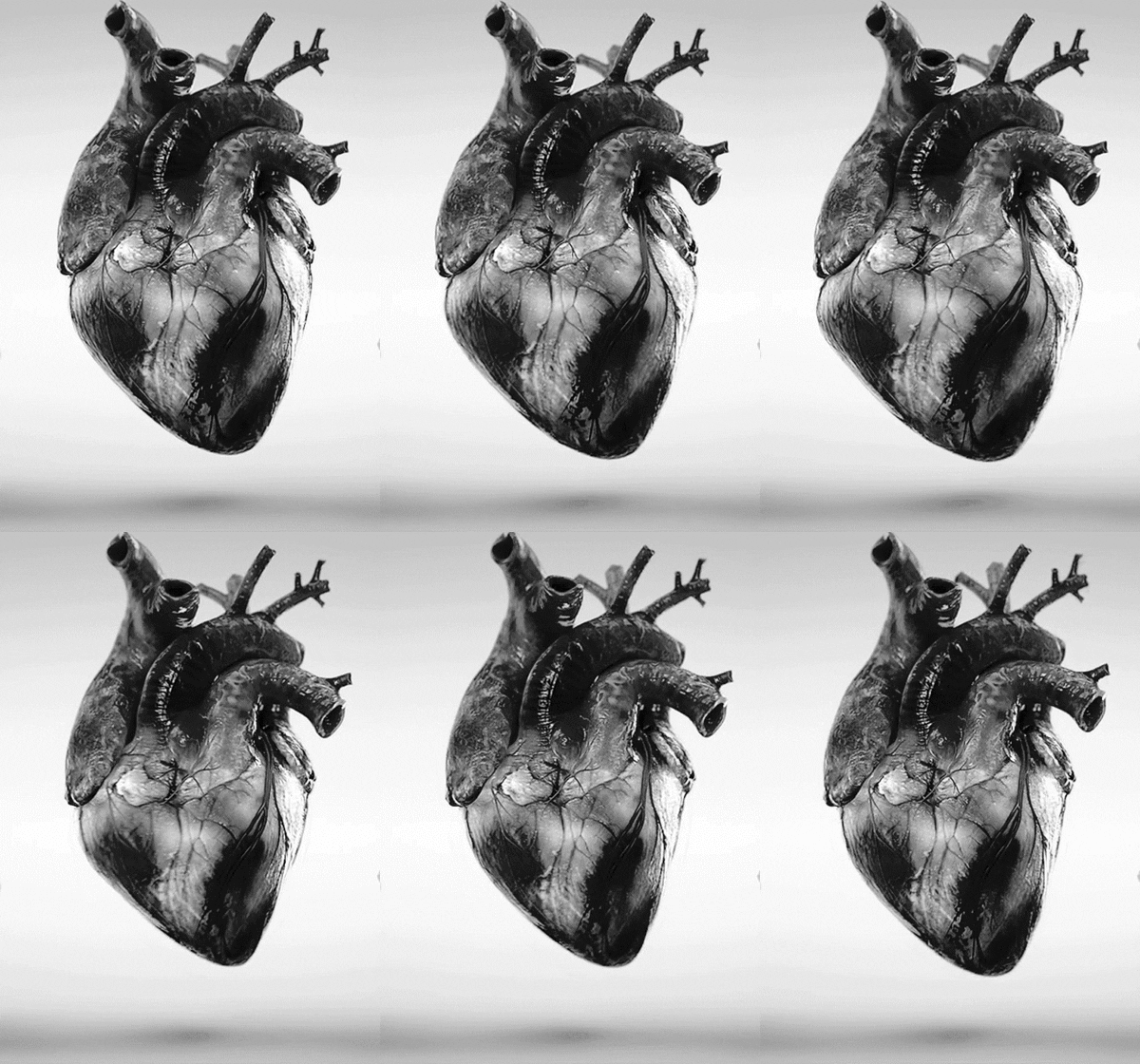
I HEART U


1. Do some revision of the Cardiovascular system via BBC bitesize

2. Meet your heart  Take notes! 

3. Build a Tiny Heart Use plasticene, do it on a paper plate. 

4. Label your tiny heart with all the directions of blood flow and veins and arteries. The video below might help.

5. Watch Khan Academy: Heart Beat

6. You may find this video also helpful Human Heart Video

7. Watch a heart dissection before you do it


Thursday, May 31, 2018

Mythbusting Microbes


Here is a link to the writing frame (your assignment sheet)
Mythbusting Microbes Write Up

1. Save a copy.
2. Open it up in docs.google.com to begin your work.  Click 'share' and 'view only' and copy the link.
3. Go to 8R SHEETS or 8G SHEETS
5. Write your name and leave the link to your work
6. Now get back to work, knowing your work won't be lost or need to be handed in!

-- Feel free to invite me to edit your work taroonawork@gmail.com --


Here is the link for interpreting your plates
Science Buddies: interpreting agar plates

I will put additional supporting material up here asap!

Sunday, April 29, 2018

Intro to Cell Organelles

Wednesday: Finished Early?
Why not play some RADICAL CELL GAMES

Centre of the Cell Games

Biomanbio Cell Games


1. Watch a couple of videos to give yourself an overview of what is inside the cell

Try: Biology Cell Structure Video

or try: Amoeba Sisters Grand Cell Tour

If you're interested in the idea of your cells being alive watch this In a Nutshell: What Are You?


2. Use the interactive at Sepup Cell Simulation to fill in your worksheet.  Filling it in in pairs is fine BUT make sure you keep the information safe - you'll need it!

Here's some puppies on a treadmill. Say 'stay fit pupper' three times and all your dreams will come true.


Sunday, March 25, 2018

ROCKS!

Resources

Your test on Thursday will involve:

1. Being able to describe the differences and similarities between igneous, metamorphic and sedimentary rocks.
2. Be able to describe how I/M/S rocks are formed
3. Be able to describe the features of a I/M/S rock
4. Identify a few different types of weathering and how it impacts rocks
5. Understand the difference between weathering and erosion
6. Identify a few common types of I/M/S rocks
7. Interpret fossils using ideas from the assignment
8. Make assumptions about igneous rocks from their crystal size


A Copy of the Power-Point from class
Geology Notes from Class

Inside the Earth & Tectonic Plates
Dynamic Earth Interactive

Crystal size and cooling rate
How is crystal size affected by cooling rate?

How Rocks are formed:
Rock Cycle

The Mohs Scale: Ranking rocks by hardness

Hardness of rocks

A pictorial guide of rock comparison
Igneous vs Sedimentary vs Metamorphic in pictures

Comparing Sedimentary, Igneous and Metamorphic Rocks
Science by Doing

This video is both extremely boring and interesting at the same time
Rock forming minerals: What are rocks mostly made of?

Another boring/interesting vid summarizing differences between M/I/S rocks

Sunday, March 4, 2018

Crystals and Cooling Rate Write Up


Discussion Questions > Either a digital or hardy copy please.

1. What is the purpose of this experiment and what do you predict will happen?

2. Make a copy of the table below and fill it in.

3. When your results are done, write a description of what you observed. Be sure to be specific and detailed in your observations.  What did you find? Was it what you expected? How did it compare to the class?  Why might it have been different to expectations?  Compare how your crystals look compared to another Year 8 student Sarah Jones in this video 

4. How does this experiment relate to igneous rocks?  Be sure to include your understanding of the rock cycle and the types of intrusive and extrusive rocks. As part of this explain why some igneous rocks, like pumice or obsidian, appear to have no crystals.  Conversely, rocks like granite seem to be full of many crystals.  Explain why this might be. 
Here is a section on the text-book to help

Table for Question 2.
Test Tube
Observations of
Ice Crystals
Observations of Air Crystals
Observations of
Cotton-Wool Crystals
Rate of Cooling (fast/slow)


Type of igneous rock that cools in similar fashion


Observations of crystals in experiment


Size of crystals in similar igneous rocks (large/medium/unnoticeable)


Tuesday, November 28, 2017

Getting Your Research Right!

Introduction: 
: a) Follow the link http://bit.ly/2BwdVpm 
  b) Fill in the columns in the Padlet https://padlet.com/kate_meijers/rnvk5autjt5o 


Step 1: Improve Your Search Terms

Using more effective search terms reduces your chances of getting unreliable webpage suggestion

Your Search Terms Matter! Click to Enlarge

Partner 1: The Art of Key Word Choices
Visit

Do the Activity
Visit

Do the activity
Explore using these tips, select and test your favourites to share with your partner

Partner 2: Word Order & Finding Words  
Visit

Do the Activity
Visit

Do the activity

OPTIONAL Already know about CTRL+F?  Learn how to search different content
Do the activity


Step 2: Take steps to be more analytical of webpages

Go back to the original search http://bit.ly/2BwdVpm  

Use the "Cheat Sheet to Researching Effectively" and the who/what/when/where guide to appraise your "most reliable website" and "least reliable website".  In pairs, do one each and then come back to discuss.

Have you changed your mind? Is this still the most reliable resource?


Summary: Have you improved?!

a) Follow the link http://bit.ly/2ibiQHy 


Thursday, November 9, 2017

Seasons


Use these resources to help you create your Earth Sun Seasons Model:

Crash Course Kids Seasons (Video)

Crash Course Kids Revolution & Rotation (Video)

Earth's Orbit put Simply (Video)

A model similar (but fancier) to what you will make (Video)

Equinoxes and Solstices Explained (Webpage)


From Wikipedia: Earth's Orbit

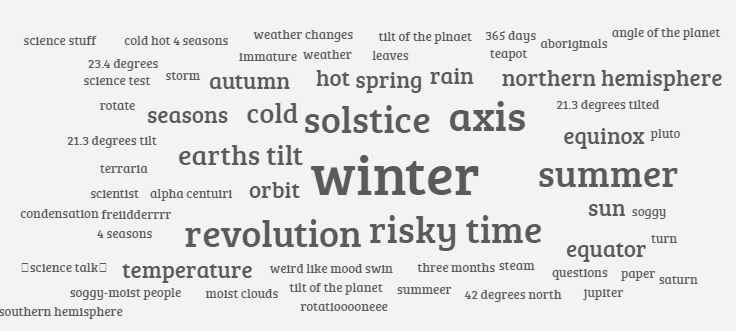
7R Word Cloud
7G Second Word Cloud 

7G World Cloud